Zeytinburnu honestly: the Panorama 1453 museum, the Theodosian walls, the Merkezefendi lodge and the medicinal plants garden, in half a day.
Walk this route
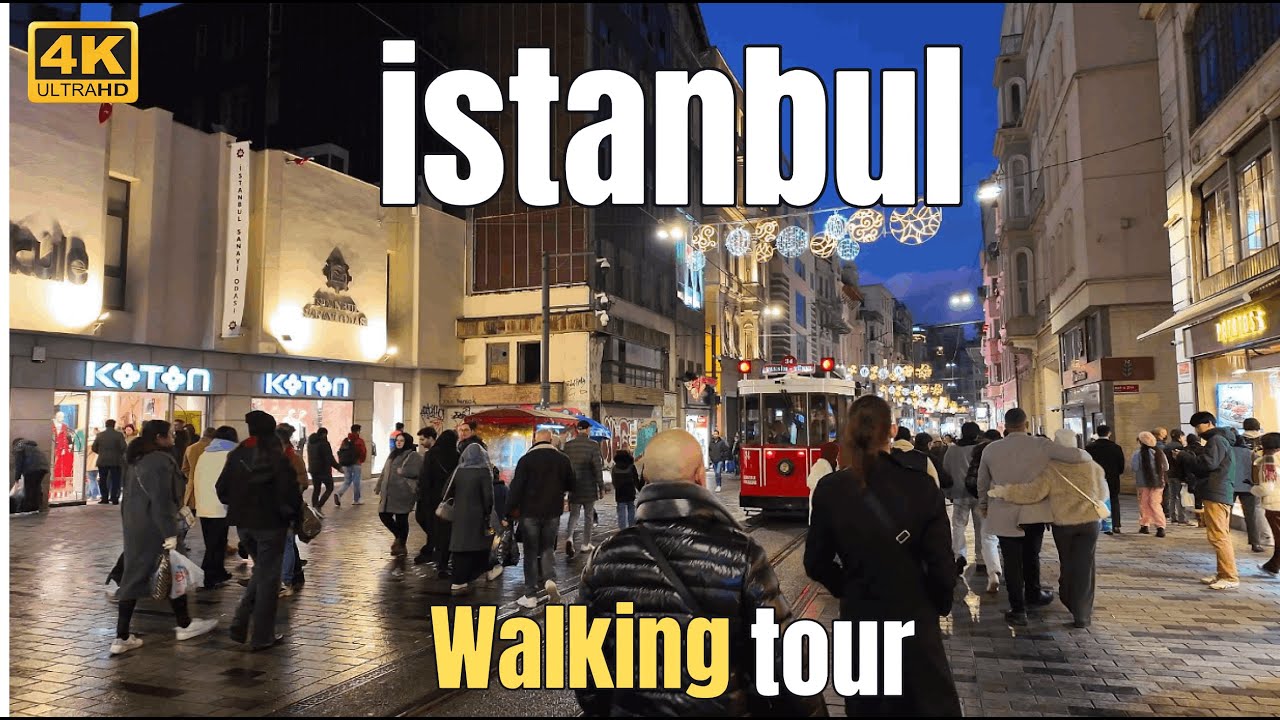
Istanbul Walking Tour 4K - Evening Walk on Istiklal Street & Taksim Square
Watch the 4K walkPlaces on the map
8 pinsNumbers match the order in the article. Tap a pin for directions.
Zeytinburnu: one museum and a wall
Zeytinburnu is a district most visitors to Istanbul only ever pass through. You see it from the Marmaray window on the way from Yenikapi to Bakirkoy, from the T1 tram between Sultanahmet and the western suburbs, or from a taxi heading to the airport. It is dense, residential and industrial: apartment blocks, textile workshops, wholesale depots and wide traffic arteries. Kazlicesme, at its southern end, was the centre of Ottoman leather tanning for centuries until the tanneries moved out in the 1990s. This is a working district, not a tourist one, and there is no point pretending otherwise.
That said, a few things here are genuinely worth your time. The first is Panorama 1453 History Museum, which opened in 2009 in Topkapi Kultur Parki and holds a full 360 degree painted panorama of the 1453 conquest of Constantinople. The second is the Theodosian land walls. Built in the 5th century, they run from the Marmara to the Golden Horn, pass straight through Zeytinburnu, and are UNESCO-listed as part of the historic areas of Istanbul. The third is the complex named after Merkez Efendi, a 16th century Ottoman physician and Mevlevi sheikh, together with the old cemetery beside it. The fourth is a municipal medicinal plants garden.
The common mistake is arriving expecting a neighbourhood to walk around. It is not one. There is no lane-by-lane charm here of the sort you get in Kadikoy or Balat. This is a trip of two or three targeted stops: see the museum, walk a stretch of the walls, add Merkezefendi and the plant garden if you have time, then leave. Who is it for? Anyone interested in Byzantine and Ottoman military history, in the walls themselves, or in the 1453 siege. Anyone on a third or fourth visit to Istanbul who has already done the classic route. If that is not you, this district does not belong near the top of your list.
Quick answer
You come to Zeytinburnu for the Panorama 1453 museum and the land walls, and for very little else.
- Panorama 1453 justifies the trip on its own; everything else is a bonus stacked on top.
- Half a day is plenty. Give it a full day and you will be padding.
- The T1 tram gets you from Sultanahmet to the Topkapi stop in about twenty minutes.
What to see in Zeytinburnu
1. Panorama 1453 Tarih Muzesi
This is the reason to make the trip. Opened in 2009 inside Topkapi Kultur Parki, the museum is built around a single room: a domed hall wrapped in a 360 degree painting of the final day of the 1453 siege. You climb a staircase onto a central platform and the scene closes around you on every side, with walls, cannon, soldiers and smoke running the full circumference. Three-dimensional objects fill the gap between the platform edge and the base of the canvas, so you cannot tell where the real ground stops and the paint begins. Sound plays throughout: artillery, drums, shouting.
It is well executed. The panorama was a popular form of mass spectacle in 19th century Europe, and few working examples survive anywhere, which makes this one unusual. Go in knowing the narrative is one-sided and built around victory. It is staging, not historical argument. The visual effect still lands, and it works on children as much as adults. Allow about an hour. Admission and opening hours change, so verify officially before you go.
2. Silivrikapi
One of the gates in the Theodosian land walls, named for the road to Silivri that started here. The gate itself sits on the boundary between Fatih and Zeytinburnu: inside the wall is Fatih, outside it is Zeytinburnu. If you follow the walls south from the Panorama museum, this is the first major gate you reach.
Today the surroundings are an ordinary neighbourhood junction. Cars pass under the arch, there is a corner shop and a tea house, and nobody stops to look. But this section of wall is relatively intact, and the towers flanking the gate and the traces of the moat still read clearly on the ground. Just outside, on the Zeytinburnu side, large cemeteries begin. The value here is not a view but a sense of scale: standing under an enormous arch, you register how thick a 5th century defensive line actually was. It is a ten minute stop, and a natural anchor point for a walk along the walls.
3. Belgradkapi
Another gate, roughly a kilometre south of Silivrikapi on the Kazlicesme side. The name is usually traced to Serbian craftsmen resettled here after Suleiman's Belgrade campaign. It is far quieter than Silivrikapi, tucked away from the main roads inside a grid of narrow streets.
The fabric of the walls is easy to read at this point. You can see the run of towers on either side of the gate, the alternating courses of stone and brick, and the visibly different material of later repairs sitting alongside the original work. Some stretches have been restored, some are simply standing, and some are crumbling. That mixture is the honest present-day condition of the walls, and it is worth seeing as a fact rather than a flaw. The streets around the gate are modest and residential. In daylight you can stand and look for as long as you like. Belgradkapi is the quietest stop on the line of walls running down towards Yedikule.
4. Merkezefendi Mevlevihanesi
Merkez Efendi was a 16th century Ottoman physician and Mevlevi sheikh, a figure who worked in both medicine and Sufism and who survives in Istanbul's popular memory as a healer. The complex carrying his name sits in the north of the district, within walking distance of the Panorama museum, and includes a mosque, a lodge, a hammam and a Quran school.
This is not a museum. It is a functioning mosque and a place of visit, with no tourist presence at all. Almost everyone here is a local coming to pray or to visit a grave. The courtyard is quiet and shaded and cut off from the noise of the rest of the district. Outside prayer times you can go in and sit for a few minutes. Cover shoulders and knees, women should cover their heads, and shoes come off at the door. The buildings have been repaired at various points across the centuries and not every part is reliably open. Twenty minutes here after the Panorama shows you a completely different face of the district.
5. Merkezefendi Mezarligi
The historic cemetery next to the complex is among the oldest and largest Ottoman burial grounds in Istanbul. It grew outward from Merkez Efendi's tomb over centuries, and holds sheikhs, statesmen, soldiers and ordinary local families side by side.
The gravestones are the interesting part. An Ottoman headstone is a piece of signage: the carved headgear on top tells you the dead man's profession and rank, women's stones carry floral motifs instead, and the calligraphy across the face records the rest. Read together, the cemetery becomes an open-air archive of who lived here and what they did. Even if you cannot read the script, the sheer variety of the forms registers immediately. Cypress trees make it a quiet place to walk. Remember where you are: keep your voice down, do not sit on the stones, and do not photograph anyone at prayer. Go in daylight. This is not a place to wander after dark.
6. Zeytinburnu Tibbi Bitkiler Bahcesi
The best-kept green space in the district, and better than you would expect. Run by the municipality, the garden grows medicinal and healing plants in beds organised by type, each labelled with the species name and its traditional use. The link to Merkez Efendi's work as a physician is not accidental; the garden deliberately connects itself to that legacy.
Inside there are greenhouses, a small plant museum section and places to sit. You do not need to care about botany for this to work. It is shaded, calm and pleasant to walk, and after the concrete density of the rest of Zeytinburnu it comes as a relief. Visitors are almost entirely local. Slot it in as a forty-five minute breather between the Panorama and the walls. Entry conditions and opening times shift from season to season, so verify officially with Zeytinburnu Municipality before making a trip specifically for it.
7. Kazlicesme
Kazlicesme is a quarter rather than a single site, and the coordinate given is an approximate centre, not a specific building. Its story is written in leather. Through the Ottoman centuries this was the empire's tanning capital, with hundreds of tanneries packed along the shore just outside the walls. They were put there for two reasons: the work needed enormous quantities of water, and it produced a stench nobody could live beside. This was an industry deliberately pushed outside the city gates.
The tanneries relocated to Tuzla in the 1990s and the quarter became something else entirely: housing blocks, open squares, a Marmaray station and a large event ground on the shore. Do not come looking for preserved tannery buildings, because there are none. What you get instead is a clear reading of where one of Istanbul's hardest trades was done, and why the city pushed it beyond the walls. It works as a piece of history, not as a sightseeing stop.
8. Kazlicesme Sahil Parki
A long shore strip along the Marmara, opened across part of the ground the tanneries vacated. It has kilometres of walking and cycling path, grass, benches and open sea views. Head west and it runs on towards the Zeytinburnu and Bakirkoy waterfront; head east and it connects towards Yedikule and the historic peninsula.
This is a city shoreline, not a holiday beach: coastal road traffic behind you, the Marmara and its shipping lanes in front. No swimming. At weekends it fills with local families, anglers, runners and picnickers; on weekdays it is quiet. At sunset you get the sun going down over the Marmara with the Princes' Islands in silhouette, which is the best view the district has. Dropping down here for half an hour after walking the walls is the easiest way to close the trip properly. The wind off the water is sharp in every season, so bring a layer.
Getting there
Zeytinburnu is easy to reach, because the district sits where several of Istanbul's busiest rail lines converge. All of them take the Istanbulkart.
**T1 tram:** the most practical option for visitors. The line runs from Kabatas to Bagcilar via Sultanahmet, Eminonu and Beyazit. Get off at the Topkapi stop for Panorama 1453, which is a short walk away. From Sultanahmet it takes roughly twenty minutes.
**Marmaray:** from Yenikapi, Kazlicesme station is only a few minutes down the line. This is the right route for the shore park and the Kazlicesme quarter, and it is also the fastest way in if you are coming from the Asian side.
**M1 metro:** the line between Yenikapi and the airport district stops at Zeytinburnu, where it interchanges with the T1 tram. Useful if you are approaching from Aksaray.
Distances between the sites are technically walkable, but the walking is not enjoyable: main roads, overpasses and traffic. Panorama to Merkezefendi is a comfortable walk. Panorama down to the shore is long and unrewarding on foot, so take a taxi or public transport for that leg.
When to go
Spring and autumn are clearly best. April, May, October and November give you weather suited to walking the length of the walls, and the plant garden is at its peak in spring. In summer there is no shade anywhere along the wall line and the middle of the day is genuinely punishing, so start early if summer is your only option. In winter, rain turns the earth around the wall base to mud and makes the stones slick, which makes for poor footing.
The order within the day is simple: Panorama in the morning, then Merkezefendi and the cemetery, the plant garden and the walls in the afternoon, the shore towards evening. Factor in the possibility of a Monday closure for museums and verify current hours officially. Around midday on Friday the mosque complex gets busy with worshippers, so do not pick that hour to visit. The shore park fills up at weekends and is close to empty midweek.
How to walk the walls
Set expectations first. There is no continuous, signposted, properly surfaced walking route along the land walls. The line is restored in places, ruined in others, and elsewhere swallowed into the surrounding neighbourhood fabric. Restoration work has been running for years, and individual sections can be fenced off without notice.
For Zeytinburnu the stretch that makes most sense is Silivrikapi to Belgradkapi, roughly a kilometre. You walk along the outside of the wall, past the edge of the cemeteries. The ground is mostly earth and rubble, so wear shoes you do not mind ruining and that grip properly. Continue south from Belgradkapi and you arrive at Yedikule.
Now the honest warnings. Do not climb the crumbling sections. The stone is loose, there are no railings, and people fall and are injured every year. Photographs of people walking along the top of the wall circulate on social media, and those spots are not safe. Parts of the wall line pass through poor and quiet areas, so go in daylight, preferably not alone, and do not walk along the base of the wall after dark. Some stretches have rubbish, rubble and people sheltering. When taking photographs in the residential lanes, do not point the camera into people's homes. None of this makes the walk unworkable. It just means going in with your eyes open.
Frequently asked questions
**Is Zeytinburnu worth a visit?** Partly. Panorama 1453 earns the trip on its own, and this stretch of the walls shows you the best-preserved defensive architecture in Istanbul. But the district itself is not somewhere to go sightseeing, and there is no street texture here to enjoy for its own sake. If this is your first time in Istanbul, leave it off the list. If you have a specific interest in history, in fortifications, or in 1453, it earns half a day.
**How much time should I allow?** Half a day. Roughly an hour for the Panorama, forty-five minutes for Merkezefendi and the cemetery, forty-five for the plant garden, an hour for the walls, half an hour on the shore. Four to five hours covers everything, which leaves your evening for another part of the city.
**Is Yedikule Fortress in Zeytinburnu?** No. It is in Fatih. It does, however, sit just over the district line, and you reach it by continuing south on foot from Belgradkapi. It pairs naturally with a walk along the walls and it makes sense to put the two in the same day. Check its current visiting status officially, since it has been intermittently under restoration for years.
**Is Panorama 1453 suitable for children?** Yes, and it is one of the museums children respond to most strongly. The hall is dark and the sound effects are loud, so very young children can be startled by the cannon fire and shouting. The subject is a battle scene. It is not gory, but violence is depicted. Over the age of about seven it is usually fine.
**Is Zeytinburnu safe?** Along the main roads, around the museum, on the shore and along the tram line, daytime safety is ordinary for a large city. The isolated stretches at the foot of the walls and some of the back streets are better avoided in the evening. Go in daylight, do not display valuables, and do not wander near the walls at night. This is the same basic caution that applies across many dense Istanbul districts.
Planning questions
What does this İstanbul guide cover?
Zeytinburnu honestly: the Panorama 1453 museum, the Theodosian walls, the Merkezefendi lodge and the medicinal plants garden, in half a day.
Can I watch a 4K walking tour of İstanbul?
Yes. The page links to Travel Walk Tours films so you can preview the İstanbul route on a big screen before you go.
How should I use this page to plan?
Read the quick answer first, skim the route notes, then compare street texture, timing, and nearby guides through the linked city page and walking films.